 Intro
 Full episode
 Clips
 Titles
What is a vodcast? Video podcasts explained
 By Matt Milne5 min read
A vodcast is a video podcast: a show recorded on camera and published to be watched as well as heard. The word is older than it sounds, and most people now just say video podcast. Video-first means the picture is planned from the start instead of added on. For the edit, it means every cut is visible, cameras are switched to follow the conversation, and silences need something to look at.
On this page
If you are getting quotes for a show for the first time, you will meet three terms that sound like three different services: vodcast, video podcast and video-first. They are closer to one idea at three strengths. This is what each means, and what it changes about the work you are paying for.
What is a vodcast?
A vodcast is a video podcast. That is the whole dictionary entry: Merriam-Webster defines vodcast in those three words and nothing else. It is a show made in episodes, recorded on camera, and published so people can watch it as well as listen.
The word turns up in search boxes, job adverts and the occasional brief, and it means the same thing as a video podcast.
| Term | What people mean by it | What it tells an editor |
|---|---|---|
| Podcast | A show in episodes, traditionally audio | Sound is the product |
| Vodcast | A video podcast, the older nickname | Same job as the row below |
| Video podcast | A conversation filmed and published to watch and to hear | Picture and sound both get edited |
| Video-first | A show planned around the picture from day one | Expect cutaways, on-screen material and more cameras |
Where did the format come from?
The surprise is that video was there almost from the start. "Podcast" itself is a blend of iPod and broadcast, coined in 2004, according to Wikipedia's history of the medium. The same article lists a serialised zombie comedy called Dead End Days, released from October 2003, as one early video podcast. So filmed shows were being put out in episodes before the audio version had settled on its name.
For most of the two decades after that, video stayed a side branch. "Vodcast" was the label for the minority of shows that had pictures. What changed was where people find shows. The same source says video podcasts were popularised in the mid-2020s, and cites a 2025 Bloomberg report that a billion people a month were watching podcasts on YouTube.
Once that many people are watching, the special word stops being needed. A filmed show is now just a podcast that happens to have its cameras on, which is why "vodcast" sounds slightly dated and "video podcast" has taken over. We compare the two formats on cost and reach in video podcast vs audio podcast; this post is only about the words and the edit.
What does video-first mean?
Video-first is the stronger version of the same idea. A video podcast can be an audio show with a camera pointed at it. A video-first show is planned on the assumption that the main audience is looking at a screen, and that changes what happens before anyone presses record.
The clearest sign we see is the recording-day checklist. One interview show in our archive had a written checklist for every guest, and the first four lines were: three camera angles, two audio files, a photo of the guest against a wall, and footage of the guest getting ready. Only one of those four lines would exist on an audio show. The photo and the getting-ready footage are raw material for the packaging round the conversation (the kind of thing a thumbnail or an opening sequence is built from), and they have to be captured on the day because nobody can go back for them afterwards.
What changes in the edit when a show is watched?
Four things, and they are worth knowing before you compare quotes.
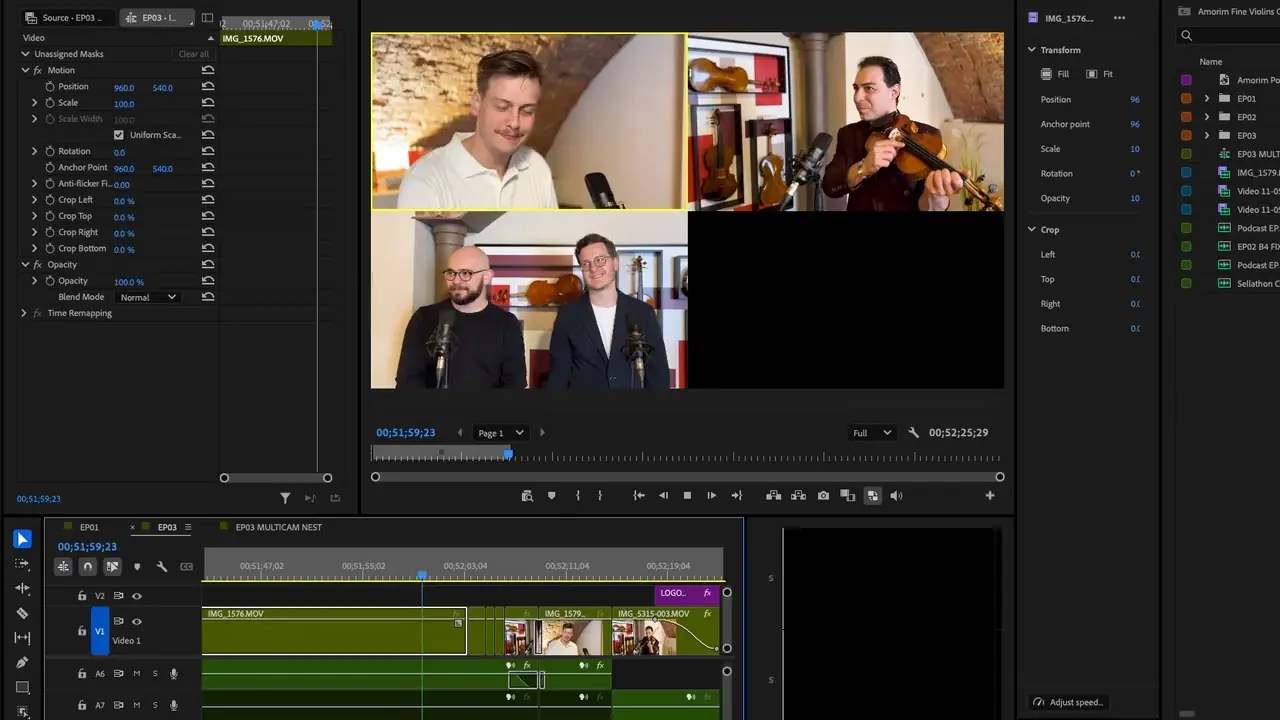
Every cut can be seen. In audio, an editor can take out a stumble, a cough or a wandering sentence and nobody will ever know. On camera, the same cut makes the speaker's head jump. So each trim has to be hidden by switching to another camera, or left in. This is the main reason a second or third angle is worth having: it gives the editor somewhere to go.
Someone has to choose who you are looking at. Camera switching is an editorial job, not a mechanical one. Cutting to the listener's reaction at the right moment is half of what makes a filmed conversation feel alive.
Silence needs something on screen. A pause in audio is just a pause. A pause on video is a person staring. A show we work on started with panel episodes, then moved to solo episodes where the host talks straight to camera, in one case reacting to clips dropped into the cut. The panels bring more recordings to line up and switch between. The solo episodes bring the opposite problem: there is no second face to cut to, so the picture has to carry the rhythm another way.
The picture has its own finishing. Cameras rarely match out of the box. One will be warmer, one darker. Matching and grading them is part of the edit in the same way mixing and mastering is part of the sound.
None of this is charged as an extra with us. A full episode edit is £280 for up to an hour, and that covers the cut, the camera switching, the sound and the colour, with revisions until you are happy. The full list is on the pricing page.
Do you need to call your show a vodcast?
No. Call it a podcast, film it if you can, and publish it wherever your audience already is. The useful question is not which word to use but how far along the scale you want to sit: audio with a camera on, or a show built to be watched.
If you are leaning towards the second, the video podcast production guide walks through the whole chain from planning to publishing.
Once it's recorded, you can see what goes into our full episode edit and what we charge for it.