
 Intro
 Full episode
 Clips
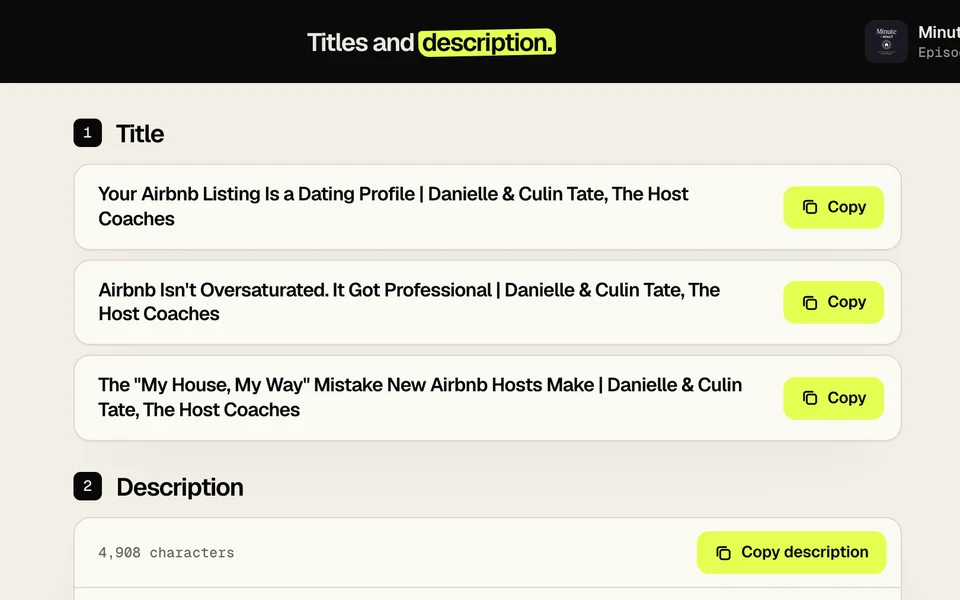
 Titles
YouTube chapters for podcast episodes: what they are and how to write them
 By Matt Milne5 min read
YouTube chapters are the timestamped section list in an episode's description. YouTube turns them into clickable segments when the first timestamp is 00:00, there are at least three in ascending order, and each chapter runs at least 10 seconds. Name each chapter so it makes sense to someone who has not watched, carrying the setup rather than a bare punchline. Write them last, from the final cut, because any re-edit moves every timestamp after it.
On this page
If you are hiring someone to edit your podcast for the first time, "chapters" will turn up in the quote, usually bundled with the title and description. This is what the word means, how YouTube uses them, and the small amount of craft that makes them useful.
What are YouTube chapters?
A YouTube chapter is a named section of a video. On the watch page, chapters show up as breaks in the progress bar, each with its own title and preview frame, so a viewer can see the shape of a 50-minute episode and jump to the part they want. For a podcast, one long conversation with no visual cue when the topic changes, that map is most of what makes the video navigable.
Chapters come from the description. YouTube reads a list of timestamps and titles from the text and turns it into the segmented bar. The same list doubles as show notes for the reader who skims before pressing play, which is why we treat the chapters and the description as one piece of writing. YouTube can also generate chapters automatically, but the results are rarely good for a conversational show, and your own list in the description overrides them.
How does YouTube read chapters from the description?
The rules are short and strict. Miss one and the list sits in the description as plain text, with no segments in the player. From YouTube's own help page:
| Rule | What it means in practice |
|---|---|
| The first timestamp is 00:00 | The list starts at the very beginning, even if that is just the cold open |
| At least three timestamps | Two sections is not a chapter list as far as YouTube is concerned |
| Timestamps in ascending order | A typo that puts 12:40 before 9:15 breaks the list |
| Each chapter at least 10 seconds | A quick aside cannot be its own chapter; fold it into the one before |
The format is plain: a timestamp, a space, then the chapter name, one per line. There is nothing to configure, which is why it is easy to get wrong without noticing. The description reads fine and the bar never splits.
How do you name chapters so they help?
This is the part that takes judgement. The common failure is naming a chapter after the moment it contains rather than the question it answers.
A guest's punchline only works as a chapter name if the name also carries the setup; a bare quote reads like a riddle to someone who has not watched. That person is reading your chapter list, and it is one of the things deciding whether they press play.
Name each chapter so it stands alone, in the words a viewer would type into search. The words in your description are words search can read, so plain, specific names do double duty.
| Weak chapter name | Better chapter name | Why |
|---|---|---|
| Intro | Cold open and who this episode is for | Tells a new viewer what they are about to get |
| "I nearly quit twice" | Why the guest nearly quit her first company, twice | The quote now carries its own setup |
| The spreadsheet thing | Pricing a service when you have no past data | Names the problem, in words people search for |
| Wrap up | Where to find the guest and her book | Tells the viewer what is left and whether to stay |
Recurring segments make this easier. One weekly finance show we edit runs the same shape every week: a deep-dive on one topic, a listener Q&A, and a personal segment at the end. Those fall into chapters naturally, and a regular viewer can jump straight to the one they came for. The name still needs that week's subject, though: "Deep-dive" on its own is a label, not a map.
Why are chapters written last?
Because chapters are tied to the edit, down to the second, and the cut is the one thing that can still move.
Say an episode's cold open runs for 45 seconds, so the first real chapter starts at 00:45, after the 00:00 entry for the open itself. Trim ten seconds from that intro and every chapter timestamp in the episode has to move up by ten seconds, because everything after the trim shifts with it.
That is the whole lesson. Chapters come from the final cut and nothing earlier. A list that is ten seconds out drops the viewer into the middle of a sentence every time they click, so any re-edit, however small, means re-checking the chapters before the description goes live.
Where do chapters come from in the production process?
For most shows, chapters are a by-product of the show-notes pass rather than a separate job. Once an episode is locked, someone has to watch it through and write the title and description anyway. Noting where each topic begins while doing that costs little extra, and the list is accurate because it came from the cut that is about to be uploaded.
At Joycast that pass is the title, description and chapters, £30 per episode on the pricing page, written to be found in search and with the timestamps included. It comes last because it has to be read from the version that ships. A well-named chapter list is also an outline for the clips, posts and newsletter sections covered in how to turn one episode into 15 pieces of content.
If you are doing this yourself, the order matters more than the tool. Lock the edit, watch it once with a notepad open, write the chapter names for a stranger, check the first line says 00:00 and there are at least three entries, then paste it into the description. If the edit changes afterwards, start again from the notepad.
Here are some of the clips we've cut, and what each one costs.